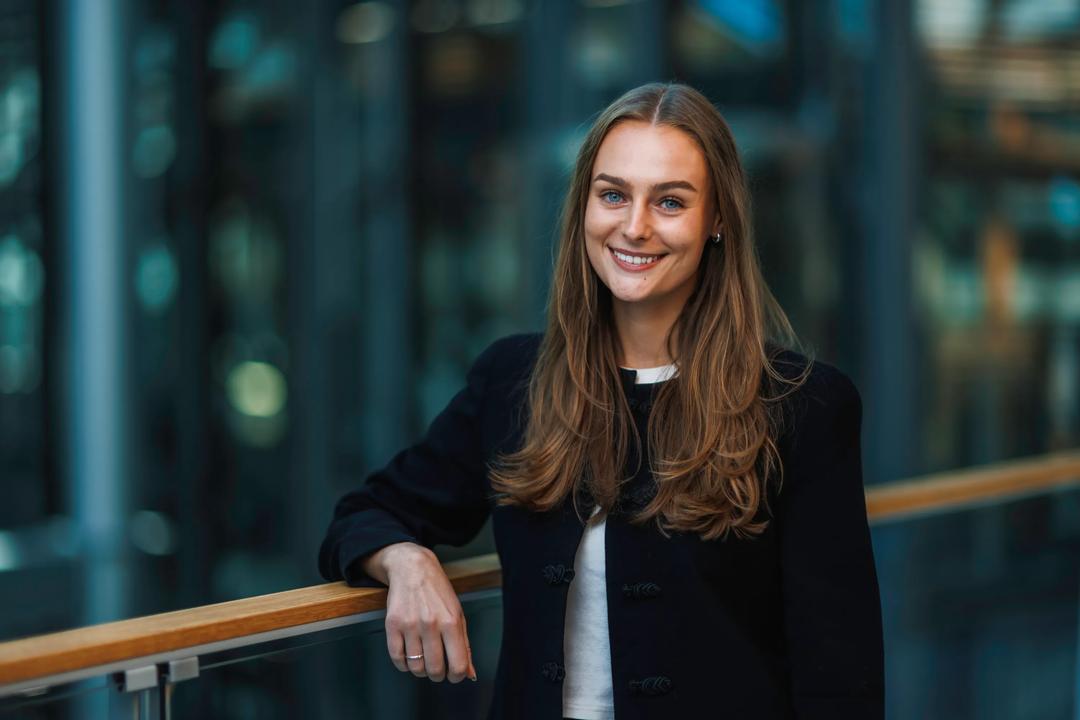
From a communications agency to a PhD: An interest in AI brought Emma back to BI
Emma Vaughan (27) had a permanent position as a communications advisor when she became curious about how artificial intelligence is changing the way we work. She has now traded agency life for a PhD in communication at BI.
How AI sparked an interest in research
It was through her job as a communications advisor at Hekt that Emma’s interest in artificial intelligence really took off. She saw first-hand how technology was changing both her day-to-day work and the services they delivered to clients.
- When I first started working at Hekt, I found it exciting to see how AI was changing the way we worked and the services we delivered. I also noticed that I suddenly felt a need to prove that I was the one who had created what I was presenting, both internally and to clients. It was a completely new feeling, and something I had never thought about before.
Vaughan believes that artificial intelligence is changing what we perceive as good communication. In the past, high-quality content may have been what mattered most, but now it may also be important to be able to prove that it was made by a human. How artificial intelligence shapes our expectations of communication is exactly what she wants to explore further in her PhD.
Doing a PhD, however, had never been part of the plan. She had imagined building a career in communications, and she had always thought of doctorates as something for people in the sciences.
Still, her curiosity about how AI was shaping communication continued to grow. After talking to a friend who is pursuing a PhD herself, the idea of researching the subject started to take shape.
- A friend suggested that I could do a PhD myself. At first, I thought it wasn’t for me, but gradually I started considering the possibility. I found AI incredibly interesting, but when you’re working, you rarely have time to stop and reflect on things like that.
From student life to agency life
Emma is no stranger to BI. After finishing high school, she spent a gap year travelling around Asia. Her love of travel made her look for a degree with international opportunities, which led her to the Bachelor of International Management at BI in Trondheim, where students spend their final year abroad. Emma headed to Sydney, Australia.
After completing her bachelor’s, she spent a year working in B2B marketing at a SaaS company, then went on to Copenhagen Business School for a master’s in business administration and communication. While studying, she also interned at Fjeldberg Westerlin, working on influencer marketing.
Once she had finished her master’s, she secured a summer internship at TRY and quickly realised she thrived in an agency environment. That experience led to a permanent role at the communications agency Hekt.

Why Emma chose BI
When Emma began exploring the idea of a PhD, she started searching for research environments in the field of communication. She came across several options, but it was BI’s Department of Communication and Culture in particular that caught her interest.
- When I read about BI’s PhD programme, I got a very good impression. The international focus and the research environment seemed especially relevant to my interests. Several of the professors also do research in areas I want to explore in depth myself. I simply felt that BI and the Department of Communication and Culture were a very good fit with what I wanted to research.
So, Emma decided to apply for the PhD position at BI, without high expectations of getting it. In fact, she didn’t apply anywhere else, and after a long application process and two interviews, she received the news she had been hoping for.
- To be honest, I never really expected to get the job, but I wanted to give it a shot. When the offer finally came, I knew right away that I’d say yes.
She says applying for the PhD was much like applying for a regular job with a few extra requirements.
- In my case, BI had advertised open positions for PhD candidates. As part of the application, I had to write a ten-page project proposal describing what I wanted to research. On top of that, I submitted a CV, a cover letter and letters of recommendation, much like any other job application.
During the interviews, she had the chance to go into more detail about her research idea, her previous experience and the methods she had used during her master’s studies.
- To me, the interview was mostly about explaining why this specific research area interested me so much.
A flexible workday with plenty of responsibility
As a new PhD candidate, Emma is still at the beginning of her doctoral journey. The first year largely consists of courses and lectures, and with five courses on her schedule, she describes the start as quite similar to the everyday life of a master’s student.
At the same time, she highlights flexibility as one of the biggest advantages of life as a PhD candidate.
- We have a lot of freedom to manage our own progress, as long as we do what we’re supposed to. I try to be at the office every day, but I also have the option to work elsewhere. If I want to work in the evening one day, for example, I can do that. In many ways it’s a regular job, just with much more flexibility
Although her working day is flexible, it also comes with the responsibility of structuring her own work. The PhD lasts four years, and later on, a quarter of her working time will be devoted to lecturing.
Besides the flexibility, Emma also praises the academic community at BI. Although she has only been a PhD candidate for a short time, she has already been very impressed.
- The atmosphere at the communication department is very open and friendly. I feel that everyone wants to help each other, and it’s also a very international environment, which I find exciting.
She particularly emphasises that both the professors and the other PhD candidates seem committed to supporting one another, and that she has been warmly welcomed.
The future is still open
Emma has only just started her four-year PhD, and it will be a long time before she has to decide what to do afterwards. Still, she has given the future some thought, and she sees both academia and the business world as possible paths.
- I’m really enjoying academia so far, and at the moment I’d like to stay on that path. But so much is happening in AI right now that it will be exciting to see what opportunities arise. Either way, I think a PhD is valuable in academia as well as in industry.
Still, career prospects weren’t what drove Emma’s decision to apply.
- I didn’t choose to do a PhD because it was a strategic career move, but because I was genuinely interested in the topic.
And although the move from agency life to academia was a big change, she is so far very happy with her choice.
- I have no regrets. I’m really happy.
Hoping more people discover the opportunity
To others considering a PhD, Emma has one piece of advice that outweighs everything else: choose a topic you are genuinely interested in.
- I would really recommend a PhD to anyone who has a topic they are passionate about. After all, you’ll be working on it for four years, so it’s important that you’re genuinely interested.
She also points to the international opportunities as a major advantage of being a PhD candidate at BI. These include funded research stays abroad and participation in international conferences.
- There are a lot of opportunities, and I genuinely feel that BI is committed to investing in us as researchers.
At the same time, Emma believes that a PhD is an option more people should know about. When she was a student herself, it was never something she had considered a natural next step.
- When I was doing my bachelor’s and master’s, nobody really talked about a PhD being an option.
That’s why she hopes more students will realise what a PhD can do for them, both academically and for their careers.
Considering a PhD?
BI offers several PhD specialisations across different academic fields. Explore the options and find out which path is right for you.