Why Norway should buy Harvard, trolling the haters, happy Norwegians, and the power of kindness. These are our most read stories of the year.
BI BUSINESS REVIEW
Society
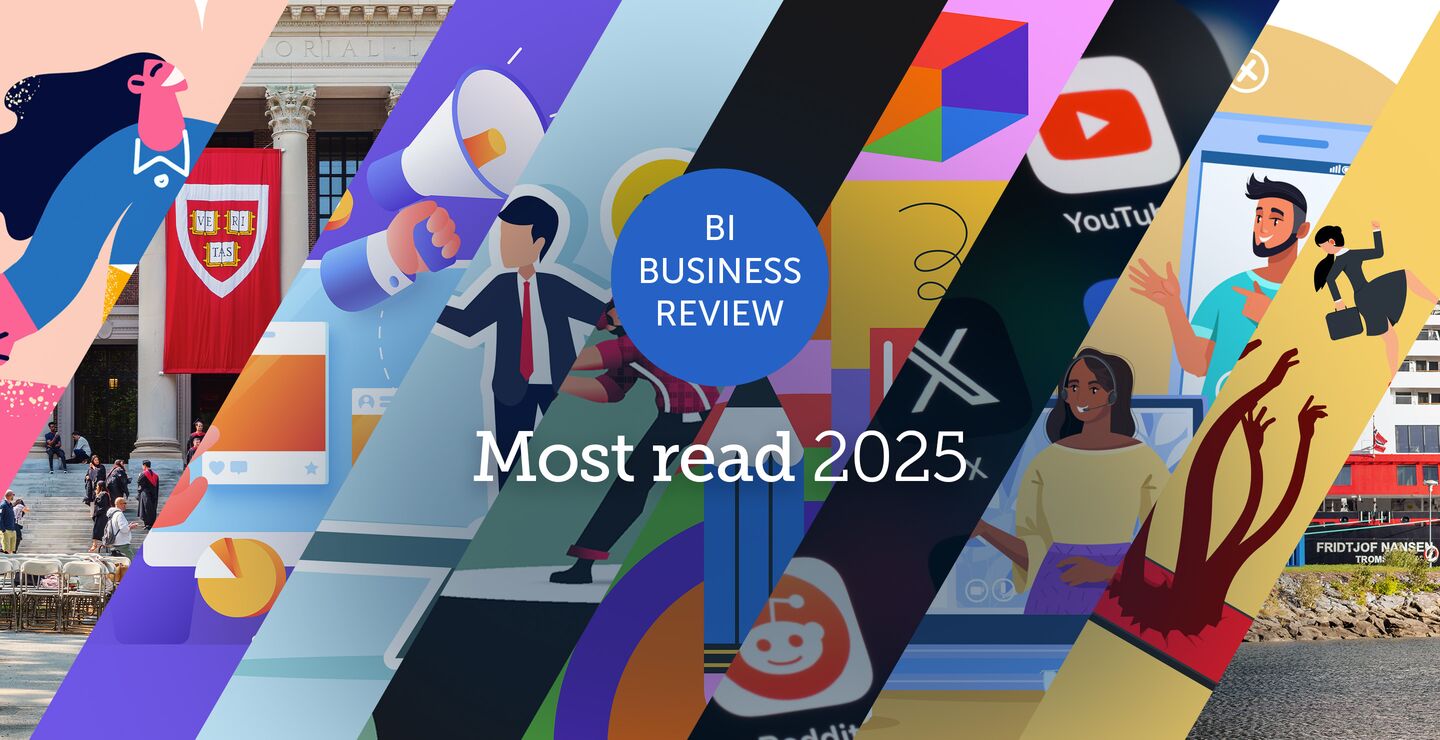
Top 10 most read articles in 2025
The extremely dedicated BI Business Review team have crunched the numbers and looked at which articles you – our dear readers – were most engaged by over the past year.
We are happy to confirm that research-based knowledge is still sought-after in 2025!
Lean back, relax, and enjoy a well-deserved reading break!
What if the key to business success wasn’t just strategy, innovation or financial acumen – but kindness? Our readers could not get enough of Federica De Molli and her piece on why businesses that cultivate kindness don’t just feel better – they also perform better.
1) Why kindness wins in business
“More and more companies are recognizing that hiring kind people isn’t just good for culture—it’s good for business. Forward-thinking HR leaders now prioritize kindness as a core hiring criterion. Why? Because kind teams outperform cutthroat ones in the long run.”
Harvard is no longer welcome in the United States. Nathan Warren claims academic excellence has never been more affordable and our readers seemed to be intrigued by him suggesting that Norway should use their oil money to buy the world-famous institution.
2) Norway should buy Harvard
“Norway could buy the entire Harvard Corporation and move it to Norway—certainly the time is right to get a good price. Norway has the money and Norway’s culture is a perfect fit with Harvard. Alternatively, Norway could invite the Harvard Corporation to relocate to Norway by investing in the research and infrastructure that are critical to the success of Harvard—and that are most threatened by the Trump administration.”
Human-AI collaboration enables marketers to turn data into engaging stories, ethically and at scale. Plenty of readers found Shubin Yu and his article on how generative AI is transforming industries and advertising highly interesting.
3) Generative advertising: when ads come alive
“A runner in Tokyo might see an ad featuring local landmarks and weather, set to her favorite playlist, urging her to "push beyond limits." Meanwhile, a Boston runner might see an ad focusing on local charity races and current weather. These ads tap into real-time data like TikTok engagement and Spotify habits to create relatable narratives.”
Everyone wants to be happy, and Norwegians are no different. In fact, we’re quite good at it. Age, income, education, and gender influence our happiness levels – but what does it take to build a happier society? Readers were seemingly very happy with Caroline Dale Ditlev-Simonsen and her investigation into which factors relate most to happiness.
4) Norwegians report high levels of happiness: these are the key influencing factors
“One of the most striking findings is how happiness evolves throughout life. Generally, happiness tends to increase with age—an encouraging insight for those who fear that youth is the peak of joy.”
Organisations are quick to celebrate success, but more inclined to erase any trace of failures, crises, and painful transitions. Federica De Molli, however, never fails to impress, with another article on our most-read list, this time on why organisational failures should not be swept under the rug.
5) The value of organizational failures: Making room for mistakes
“Patagonia, for instance, has built a culture of radical transparency, where past environmental mistakes and strategic missteps are shared openly. The company discusses its failures in material sourcing, past decisions, and ecological impact. Rather than weakening the brand, this strengthens the trust of customers and employees, positioning Patagonia as an authentically self-critical company.”
Generative AI is reshaping how businesses identify consumer needs, develop products and services, and design packaging and communication. Carlos Velasco and his colleagues engaged readers when they discussed how the new technology accelerates the conceptualisation, design, and testing of market offerings.
6) Can AI facilitate market research and innovation?
“Traditional consumer testing is slow and expensive. GenAI offers an alternative via “silicon samples”: synthetic respondents simulating human responses. Large language models can reproduce sensory associations, such as linking rounded shapes and red hues with sweetness. ”
Misinformation is here to say (for now). That does not mean there is nothing to do about it. And one of those people doing something about it? Anton Gollwitzer. And this article.
7) What can we do about misinformation?
“Regulating misinformation must become a societal priority. We already regulate industries that pose significant risks—like food safety, transportation, and finance—because the costs of inaction are simply too high. Why should misinformation be treated any differently?”
Virtual work has changed the modern workplace. But does equipping our teams with fancy tools ensure effective communication? Sut I Wong and her colleagues investigate how the sociability and effectiveness of teams can be harmed when team members do not synchronize how tools are used.
8) The Silent Killer of Teams: Unmasking Communication Gaps
“When communication patterns clash it creates distinct subgroups. This makes it harder to build social connections across the divides. Think of the 'water cooler' moments or informal check-ins – these become less frequent or effective when subgroups operate in separate digital spaces. This decline in sociability, the study found, makes aligning efforts become much harder. ”
When discussions online turn sour, it’s easy to blame trolls, moderators or platform governance. But research from BI’s Eliane Bucher and Suzanne van Gils shows that incivility is also caused by how people and technology interact within what they call a sociotechnical system.
9) Defending your own or trolling the haters?
“In close-knit settings, a cutting remark about an outsider can strengthen in-group bonds. In scattered communities, playful banter can help maintain engagement, even if it occasionally crosses the line.”
Many factors influence the uncertainty under which firms make investment decisions. But can maritime industries lead the way in proactive investment and market switching? Yes, argues Randi Lunnan in this article.
10) Not mission impossible
“Market switching has a cost, but proactive investments reduce this cost, allowing capitalization on volatile and short-term market opportunities. Our research shows that proactive investments make these strategies more viable.”
Published 18. December 2025
You can also
see all news here.